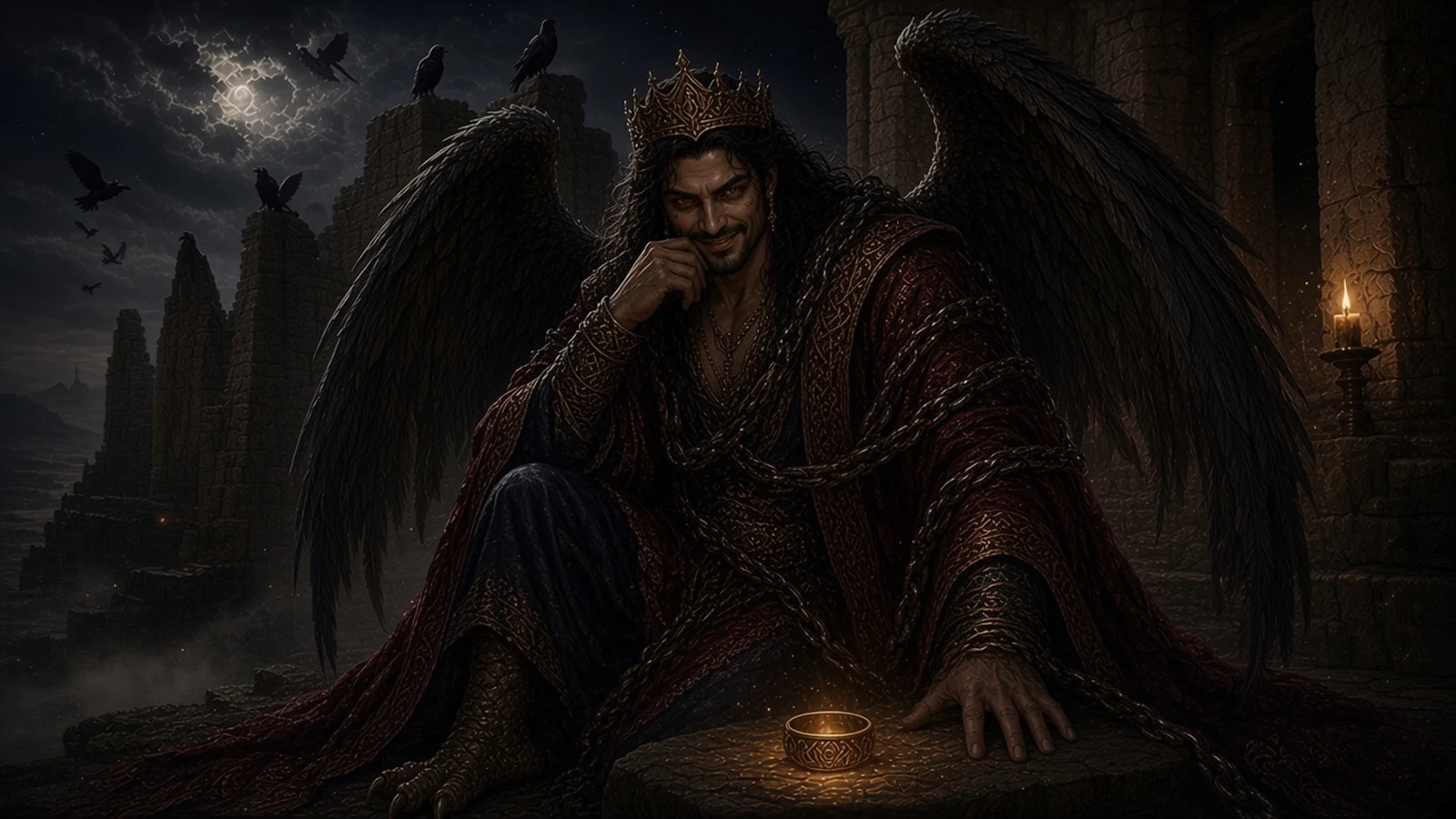
Lore Card
He has killed seven bridegrooms on seven wedding nights. In the Book of Tobit, Sara of Ecbatana has married seven times, and each husband died before he could touch her. The maids taunt her that she strangled them. The killer is Asmodeus, "the evil spirit" (Tobit 3:8).
The legend
In Tobit, heaven hears Sara's prayer and sends the angel Raphael, disguised as a traveling kinsman, to bind the demon (3:17). Along the way young Tobias catches a fish, and Raphael tells him to keep its heart, liver and gall. On the wedding night Tobias burns the heart and liver, and the smoke drives the spirit "into the utmost parts of Egypt, and the angel bound him" (8:3, KJV).
The Talmud makes him a king. Ashmedai, king of the demons (Gittin 68a; Pesachim 110a), lives on a mountain beside a well he seals each day. Solomon needs the shamir, a creature that splits stone, because no iron may cut the stones of the Temple. He sends Benayahu son of Jehoiada with a chain and a ring engraved with God's Name, plus fleeces and wineskins. Benayahu drains the well, fills it with wine, and chains the drunken demon.
The demon on the road is unexpectedly wise. Ashmedai weeps at a wedding and laughs at a man who orders shoes to last seven years, because he knows how little time both of them have left. He tells Solomon that the shamir belongs to the Prince of the Sea, who entrusts it only to the hoopoe.
Then comes the reversal (Gittin 68b). Solomon asks what makes demons greater than men. Ashmedai says he will show him if Solomon removes the chain and hands over the ring. Solomon does. The demon swallows the ring, stretches one wing to heaven and one to earth, flings Solomon four hundred parasangs away, and sits on his throne.
Versions
- Testament of Solomon: Asmodeus is interrogated and bound to work on the Temple.
- Etymology: Scholars commonly connect the name to the Avestan aēshma, the demon of wrath.
- Lesage (1707): a witty devil who lifts the roofs of Madrid.
What fantasy gets right / what it misses
Gets right: a demon of lust and marriage, royal rank, and a binding through names and rings.
Misses: The Talmud's Ashmedai is not a brute. He is ironic, prophetic and very nearly a sage, and he exposes the vanity of the wisest king. He is a trickster who wins the argument.