Lore Card
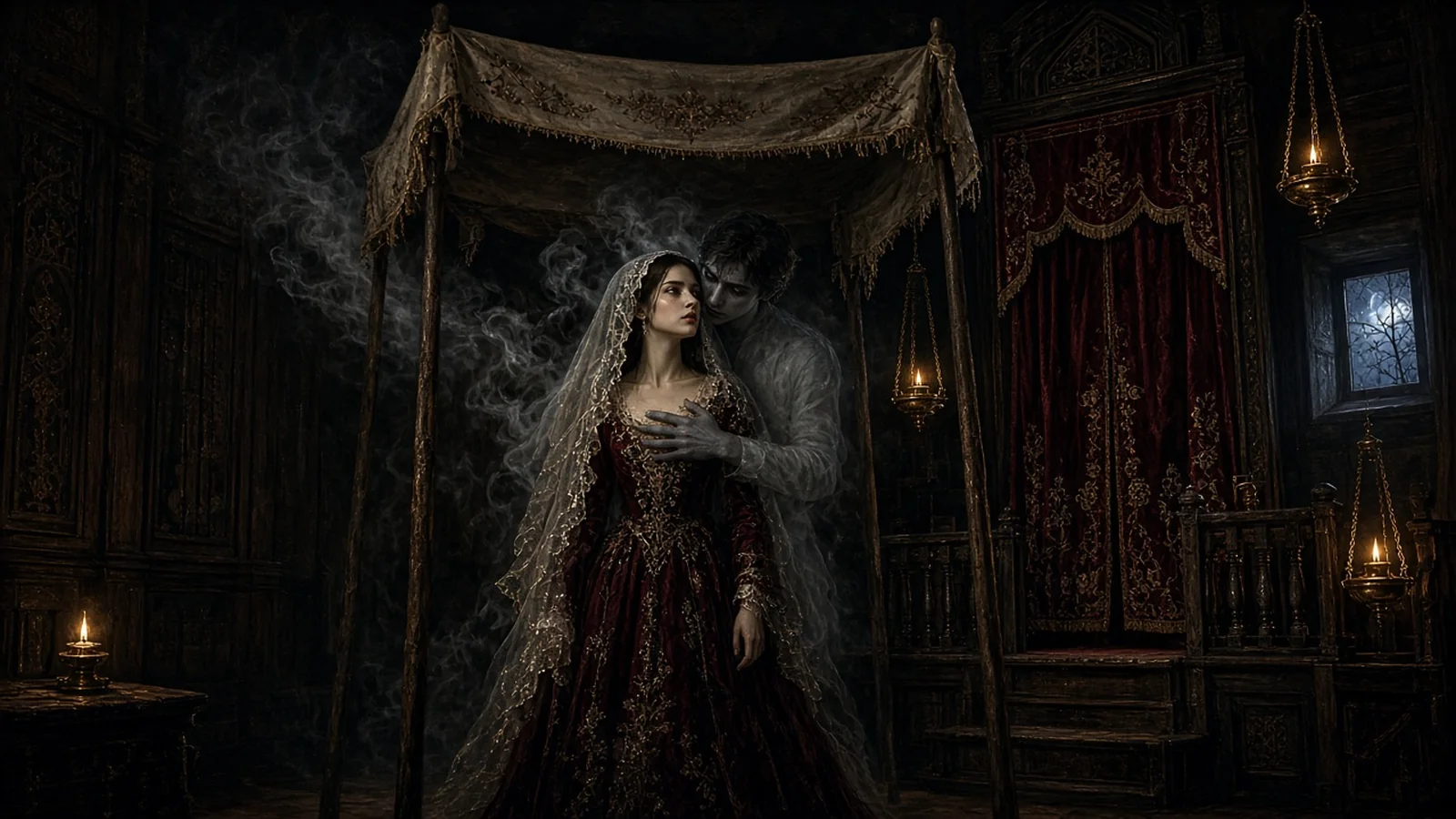
A bride stands under the wedding canopy and speaks in a dead man's voice. This is the scene audiences remember from S. Ansky's The Dybbuk. Leah is about to marry a stranger, and her true beloved, Khonen, who died calling on forbidden powers, enters her body and refuses to leave.
The legend
The word comes from the Hebrew root d-b-k, "to cling". A dybbuk is not a demon. It is a human soul, someone who died with sins unatoned or business unfinished, and who cannot find rest. It takes refuge in a living body, usually a young woman's, and speaks through her: new voices, forbidden knowledge, the dead man's grievances.
The name in this sense is early modern. By the 17th century, Yiddish and Hebrew accounts described the dibbuk of an evil spirit and the rabbis who drove it out. The roots are much older. An "evil spirit from God" torments King Saul, and only David's lyre brings relief (1 Samuel 16:14–23). Josephus says he watched a Jew named Eleazar, in front of Vespasian and his soldiers, draw a demon out through a man's nostrils with a ring holding a root prescribed by Solomon (Antiquities 8.45–49). Kabbalistic teaching on gilgul, the transmigration of souls, was greatly developed by the mystics of 16th-century Safed. It gave the wandering dead a theology.
The exorcism was a public ritual. A rabbi, a quorum of ten, psalms and the shofar's blast questioned the spirit: Who are you? Why have you come? The aim was not only to expel it but to mend the wrong, so the soul could finally go on.
Versions
- Ansky's play (written in the 1910s, first staged in 1920; the Habima Theatre's Hebrew production followed in 1922) turned possession into a tragic romance between destined lovers.
- Folk accounts often show the possessed woman voicing what her community would not let her say.
What fantasy gets right / what it misses
Gets right: the changed voice, the clinging, the unfinished business, and the courtroom-like exorcism.
Misses: Horror tends to treat the dybbuk as a demon. In the tradition it is a suffering person, and the rite tries to heal the spirit as well as the host. The "haunted dybbuk box" is a 21st-century internet legend, not Jewish folklore.